
How to Actually Use Google Gemini
Artificial intelligence (AI) is no longer a far-off concept from science fiction; it is a present-day reality, deeply woven into the fabric of our daily lives. Many people interact with AI without even realizing it, from the voice assistants on our phones like Siri and Alexa to the personalized recommendations that suggest what to watch next on Netflix or listen to on Spotify. Navigation apps such as Google Maps leverage AI to analyze real-time traffic data, finding the most efficient route to a destination. These applications work quietly in the background, making life more convenient.
However, the latest wave of generative AI offers something more: the opportunity to move from being a passive beneficiary to an active user. This article serves as a practical guide to intentionally harnessing this power, with a focus on Google’s flagship AI, Gemini. Whether for those who are skeptical, curious beginners, or early adopters, the goal is to provide the knowledge needed to use these transformative tools confidently, effectively, and responsibly.
The Double-Edged Sword of AI: A Balanced Perspective
The rapid proliferation of AI has sparked both excitement and apprehension. To navigate this new landscape, it is essential to hold a balanced view, acknowledging not only the technology’s transformative potential but also its inherent risks and limitations.
The Promise of AI: Augmenting Our Daily Lives
At its best, AI acts as a powerful amplifier of human capability, streamlining tasks, personalizing experiences, and unlocking new frontiers of knowledge.
- Enhanced Efficiency and Productivity: One of the most significant benefits of AI is its capacity to automate repetitive and mundane tasks. Whether it’s sorting through large datasets, managing emails, scheduling meetings, or summarizing lengthy documents, AI can handle processes that would otherwise consume valuable time. This automation reduces human error, ensures consistency, and frees up individuals to focus on more complex, creative, and strategic work. The result is a boost in productivity that can lead to a better work-life balance.
- Unprecedented Personalization and Convenience: AI excels at tailoring experiences to individual needs and preferences. This extends far beyond simple product recommendations. AI-driven educational platforms like Duolingo create personalized learning plans that adapt to a student’s pace. It can generate custom travel itineraries, help manage personal finances by analyzing spending habits, and provide 24/7 assistance through chatbots and virtual assistants, making support and information instantly accessible at any time.
- New Insights and Improved Decision-Making: AI systems can process and analyze massive volumes of data at speeds unattainable by humans, revealing hidden patterns and trends. This capability drives better decision-making across numerous fields. In healthcare, AI algorithms can help detect early signs of diseases like cancer from medical images, potentially saving lives. In business, AI can forecast market trends by analyzing consumer behavior. It can even contribute to solving global challenges, such as by optimizing renewable energy systems to help mitigate climate change.
- Accessibility and Safety: AI offers powerful tools that enhance accessibility for people with disabilities, breaking down barriers to information and communication. Furthermore, AI can significantly improve human safety. By deploying AI-powered robots to perform dangerous tasks—such as defusing bombs, exploring deep oceans, or working in environments with high radiation—the risk to human life is eliminated.
The Perils of AI: Navigating the Risks with Open Eyes
Alongside its immense promise, AI presents a complex set of challenges that demand careful consideration and responsible management.
- Ethical and Societal Dilemmas: The most prominent concern surrounding AI is the potential for job displacement as automation handles tasks traditionally performed by humans. While AI is also a creator of new jobs, the transition creates understandable anxiety and necessitates societal investment in retraining and support. Beyond economics, there are concerns about the erosion of genuine human connection as interactions with AI become more common, and the risk that over-reliance on AI could lead to a decline in critical thinking skills.
- Data, Bias, and “Hallucinations”: A fundamental limitation of AI is that a system is only as good as the data it is trained on. This data dependency is the root of several key problems. If the training data is flawed, incomplete, or reflects existing societal prejudices, the AI will learn and perpetuate those prejudices. This phenomenon, known as “algorithmic bias,” can lead to unfair and discriminatory outcomes in critical areas like hiring, credit scoring, and law enforcement.This same data dependency can also cause “AI hallucinations,” a term for when an AI generates false or misleading information and presents it as fact.
- Privacy and Security Concerns: Many of the most powerful AI models, known as Large Language Models (LLMs), are trained on enormous datasets scraped from the public internet, often without the explicit consent of the original creators. This practice raises significant data privacy questions. Users must be cautious about sharing sensitive personal or proprietary company information with public AI platforms, as that data could be exposed or used in unintended ways.Concurrently, cybercriminals are exploiting AI to launch more sophisticated attacks, using it to craft convincing phishing emails and other fraudulent content that is harder to detect.
- The Threat of Misinformation and Deepfakes: One of the most alarming risks is the rise of “deepfakes”—hyper-realistic video, audio, or images generated by AI to convincingly imitate real people. This technology can be weaponized to spread dangerous misinformation, defame individuals, commit fraud, and create new forms of harassment. The proliferation of deepfakes erodes trust in digital media and makes it increasingly difficult to distinguish truth from falsehood, highlighting an urgent need for robust detection tools, digital literacy education, and clear regulations.
The connection between an AI’s dependence on data and the ethical dilemmas it creates is direct and unavoidable. An AI model’s worldview is shaped entirely by the information it is fed. Since this data is often a reflection of our world, complete with its historical and systemic biases, the AI inevitably learns and can even amplify these flaws. Consequently, an algorithm trained on biased hiring data may unfairly favor certain candidates, or a facial recognition system may perform less accurately for marginalized groups. This reveals that addressing AI bias is not just a technical challenge of cleaning data but a societal one that requires continuous human oversight and a commitment to fairness.
This duality also extends to security. While malicious actors can use AI to design new threats, from novel chemical weapons to autonomous drones, AI is simultaneously our most powerful defense against them. AI-powered security systems are essential for detecting AI-generated scams, predicting cyberattack patterns, and responding at machine speed—far faster than any human could. This creates a dynamic where AI is used for both offense and defense, an ongoing technological arms race. It suggests that opting out of AI is not a viable strategy; rather, engaging with it responsibly and developing robust, ethical defenses is a necessity.
Meet Gemini: The Evolution of Google’s Flagship AI
To understand what Gemini is today, it is helpful to look at its origins—a story of intense competition, strategic pivots, and rapid technological advancement that reflects the broader AI industry.
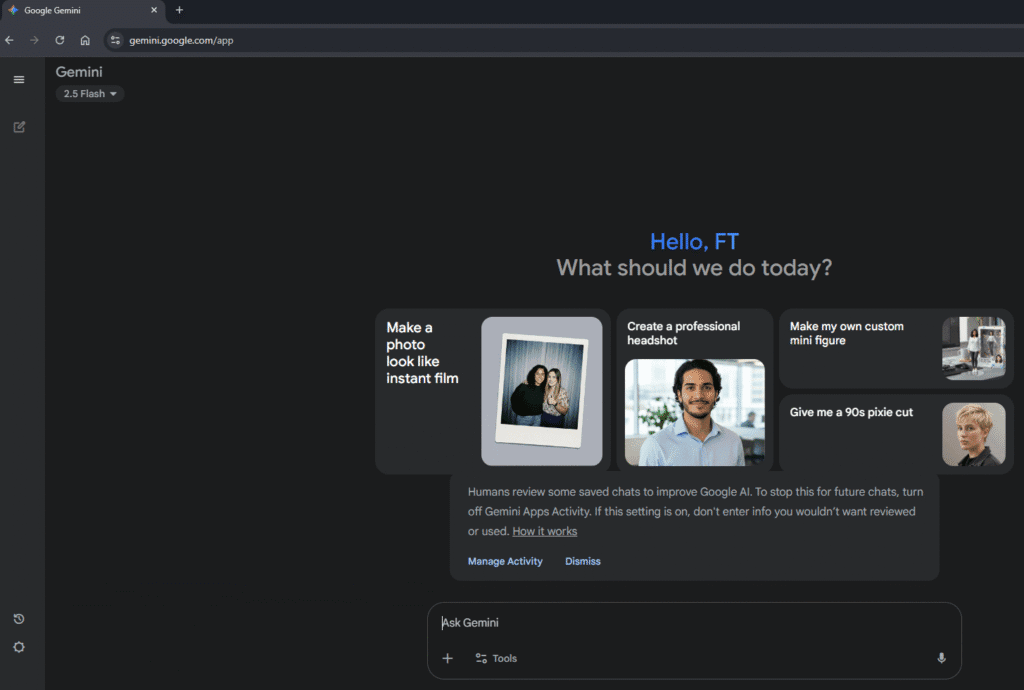
From ‘Code Red’ to Conversational Partner: A Brief History
The public launch of OpenAI’s ChatGPT in November 2022 sent shockwaves through the tech industry and reportedly triggered a “code red” alert within Google. The viral success of ChatGPT was seen as a potential threat to Google’s core search business, prompting an urgent mobilization of resources. In a rare move, company co-founders Larry Page and Sergey Brin, who had stepped back from daily operations, returned to participate in strategic meetings to shape Google’s response.
At the time, Google already possessed powerful in-house LLMs, such as LaMDA (Language Model for Dialogue Applications), but had been hesitant to release them to the public, citing significant “reputational risk” associated with the technology’s potential for generating inaccurate or harmful content. However, the competitive pressure mounted, forcing a change in strategy.
In February 2023, Google introduced Bard, its first public-facing conversational AI. Powered initially by LaMDA and later by the more advanced PaLM 2 model, Bard was positioned not as a search engine replacement but as a “collaborative AI service” designed to be a creative partner. This initial launch was Google’s entry into the burgeoning generative AI race. The final major shift occurred in early 2024, when Google retired the Bard brand and renamed its flagship AI Gemini, signaling a transition to a new, more powerful, and fundamentally different family of AI models.
The Gemini Family Tree: From 1.0 to the Agentic Era
The evolution of the Gemini models represents more than just incremental upgrades; it marks a series of paradigm shifts in what the AI is designed to do.
- Gemini 1.0 (December 2023): The Multimodal Breakthrough. The first generation of Gemini was a significant leap forward because it was designed from the ground up to be “natively multimodal”. Unlike previous models that were primarily text-based, Gemini 1.0 could seamlessly understand, combine, and reason across different types of information at once, including text, images, audio, video, and computer code. This first version was released in three sizes to suit different needs:
- Gemini Ultra, the largest and most capable model for highly complex tasks
- Gemini Pro, a versatile model for scaling across a wide range of applications
- Gemini Nano, an efficient model designed to run directly on mobile devices like the Pixel 8 Pro
- Gemini 1.5 (Mid-2024): The Context Window Explosion. The key innovation of the 1.5 generation was a massive expansion of the model’s “context window”—the amount of information it can process in a single request. With a context window of up to 1 million tokens (the basic units of data for an LLM), Gemini 1.5 Pro became capable of analyzing entire books, hours of video footage, or extensive codebases in one go. This unlocked new capabilities for deep analysis of large documents and media files. This generation also introduced Gemini 1.5 Flash, a lighter and faster model optimized for speed and efficiency.
- Gemini 2.0 & 2.5 (Late 2024/2025): The Dawn of the “Agentic Era.” The latest evolution of Gemini introduces the concept of “agentic AI”. This marks a fundamental shift from a reactive AI that simply answers questions to a proactive one that can understand a high-level goal, formulate a multi-step plan, and execute that plan with a degree of autonomy. A prime example of this is the Deep Research feature, which can autonomously browse hundreds of websites to gather information and compile a comprehensive report on a complex topic. The Gemini 2.5 family—comprising Pro, Flash, and Flash-Lite—is built for this new era, incorporating advanced capabilities like “adaptive thinking,” which allows the model to dynamically adjust its computational effort based on the complexity of a task to balance performance and cost.
This evolutionary path reveals a clear strategic direction. The initial phase with Bard focused on mastering conversation. The second phase, with Gemini 1.0, was about understanding the world in all its formats—text, images, video, and sound. The current phase, with Gemini 2.0 and beyond, is about taking action in that world. This progression from a tool one asks questions to a partner that accomplishes tasks has profound implications for how AI will be integrated into software and daily routines.
Gemini in Action: Current Features and Future Horizons
While the technology behind Gemini is complex, its application in everyday life is becoming increasingly practical and accessible. This section explores what Gemini can do today and provides a glimpse into the officially announced features coming soon.
Your Multimodal Assistant Today
Gemini’s native multimodality and deep integration with Google’s ecosystem unlock a wide range of powerful capabilities that are available right now.
- Beyond Text: A Conversation with Your World: Gemini moves beyond text-based chat with features like Gemini Live, which enables natural, back-and-forth spoken conversations. Users can interact with the world around them through their device’s camera. For instance, one can point their phone at a broken appliance and ask for step-by-step repair guidance, get real-time feedback on an outfit, or ask questions about a landmark they are seeing. The ability to upload images, documents, and even share a screen for live assistance makes the interaction richer and more context-aware.
- The Connected Ecosystem: Gemini and Your Google Apps: A key strength of Gemini is its ability to connect with and orchestrate tasks across the Google apps many people use daily, including Gmail, Docs, Drive, Maps, Keep, and YouTube. This allows for powerful, cross-application workflows executed with simple, natural language prompts. For example, a user could ask Gemini to:
- “Find the flight confirmation in my Gmail, create a calendar event for the trip, and show me directions to the airport in Google Maps”.
- “Summarize the key points from the last five emails I received from my project manager”.
- “Watch this YouTube video on how to make guacamole and create a shopping list for the ingredients in Google Keep”.
- Your Creative Partner: Generating Images and Video: Gemini is also a powerful creative tool. Models like Imagen 4 can generate high-quality images from descriptive text prompts. A specialized model, known informally as “Nano Banana” (officially Gemini 2.5 Flash Image), went viral for its advanced photo editing capabilities, allowing users to make complex changes to images with simple instructions. Furthermore, with the Veo 3 model, Gemini can generate short, high-quality videos, such as turning a still photograph into an animated 8-second clip with synchronized sound.
While other AI models offer similar generative capabilities, Gemini’s distinct advantage lies in its native integration within Google’s vast and interconnected ecosystem. It is being woven directly into products used by billions of people, including Android, Chrome, Search, and Google Workspace. This deep integration enables complex, cross-app workflows that are difficult for standalone applications to replicate. The strategy is not merely to build the most powerful model, but to build the most useful one by placing it directly within the digital environments where people already live and work.
A Glimpse into Tomorrow: What’s Next for Gemini?
Google has announced a major strategic shift for its smart home platform, positioning it as the next frontier for conversational and proactive AI.
- The Intelligent Home: Gemini Replaces Google Assistant: Starting in October 2025, Google will begin replacing the familiar Google Assistant with Gemini for Home on its smart speakers and displays. This upgrade, which applies to even the oldest Google Home devices, represents a fundamental change in how users will interact with their smart home. The shift is from rigid, transactional commands (e.g., “Hey Google, turn on the bedroom lights”) to more natural, conversational, and context-aware requests (e.g., “Hey Google, make the living room feel cozy for a movie night”).
- Gemini’s advanced reasoning will allow it to handle multi-step, ambiguous requests. For example, a user could say, “I’m planning an outdoor party this weekend, what day looks best?” and Gemini could check the weather forecast and respond accordingly. This transforms the assistant from a simple command-taker into a helpful partner.
- This enhanced intelligence also extends to security. With Gemini integrated into Nest cameras and doorbells, users will be able to search their video history using natural language. Instead of scrubbing through hours of footage, one could simply ask, “Show me when the delivery driver dropped off a package yesterday”. While the core upgrade will be widely available, some of the most advanced features, such as free-flowing “Gemini Live” conversations, will require a subscription.
This transition is more than a product update; it signals a strategic effort to use the smart home as a prime environment for developing the next generation of personal AI agents. A home provides a contained, data-rich setting where an AI can learn a user’s habits, preferences, and routines. This allows it to move from being reactive to proactive—anticipating needs rather than just responding to commands. For example, it could learn to automatically adjust the thermostat when it detects everyone has left the house, based on phone locations and calendar schedules. The smart home is thus becoming a key space for refining the helpful, agentic AI of the future.
| Feature | Google Assistant (Legacy) | Gemini for Home (New) |
| Interaction Style | Transactional Commands (e.g., “Turn on lights”) | Conversational & Contextual (e.g., “Make the living room cozy for a movie”) |
| Multi-Step Requests | Limited (Requires manual setup of “Routines”) | Native & Dynamic (e.g., “Plan a menu and ask about dietary restrictions”) |
| Camera Integration | Basic Alerts (e.g., “Person detected”) | Natural Language Search (e.g., “Show me when the cat knocked over the plant”) |
| Automation Setup | Manual (Rule-based setup in the app) | Conversational (e.g., “Lock the doors and turn off the lights at bedtime”) |
| Underlying AI | Older, task-specific models | Latest Gemini models with advanced reasoning |
Expanding the Ecosystem: NotebookLM and AI Studio
Beyond the main Gemini app, Google has developed a suite of specialized tools that leverage Gemini’s power for more specific tasks. NotebookLM and AI Studio are two of the most significant, catering to knowledge workers and developers, respectively.
NotebookLM: Your Personal Research Assistant
NotebookLM is an AI-powered research and writing tool designed to be a “virtual research assistant”. Its key differentiating feature is that it is grounded in source materials provided by the user. Unlike a general-purpose chatbot that draws information from the entire internet, NotebookLM becomes a personalized expert only on the content uploaded to it, such as PDFs, Google Docs, website links, audio files, and even YouTube videos.
Once sources are uploaded into a “notebook,” Gemini’s multimodal capabilities are used to analyze, summarize, and synthesize the information. This creates a powerful tool for a variety of use cases:
- For Students: A student can upload lecture notes, textbook chapters, and academic papers to have NotebookLM generate a study guide, create practice quizzes, or explain complex concepts in simple terms.
- For Professionals: A project manager can upload meeting transcripts, project plans, and market research reports to quickly identify key trends, generate a briefing document for a stakeholder, or outline a presentation.
- For Creatives: A writer can upload brainstorming notes, interview transcripts, and background research to help organize their thoughts, develop a story outline, or uncover new ideas.
Two features make NotebookLM particularly innovative. First, the “Audio Overview” function can automatically turn the source documents into a conversational, podcast-style discussion, offering a new way to absorb information while multitasking. Second, to build trust and ensure accuracy, every answer generated by NotebookLM includes citations that link directly back to the specific passages in the original source documents, effectively eliminating the risk of AI “hallucinations”.
AI Studio: The Developer’s Playground
While NotebookLM is for analyzing existing information, Google AI Studio is for creating new AI-powered applications. It is a free, web-based tool that provides a direct path for developers, students, and researchers to experiment with the latest Gemini models and build with the Gemini API. It is designed to be the “fast path from prompt to production”.
AI Studio is for anyone who wants to move beyond simply using Gemini within Google’s products and start building their own custom AI tools. It provides an accessible environment to:
- Prototype and test prompts to see how different models respond.
- Tune models for specific tasks or to adopt a particular persona.
- Generate an API key, which allows the AI functionality to be integrated into a website, an app, or an automated workflow.
Even for those without deep technical expertise, AI Studio serves as a powerful sandbox for exploring the raw capabilities of the Gemini models.
An Integrated Workflow in Practice
These tools are designed to work together, forming a powerful workflow from research to production. Consider this practical example:
- Research (Gemini): A marketing analyst uses the Deep Research feature in Gemini to generate a comprehensive report on emerging trends in their industry.
- Synthesis (NotebookLM): They upload this report into a NotebookLM project, along with internal sales data and transcripts of recent customer feedback calls. They then ask NotebookLM to “Identify the top three customer pain points and create an outline for a marketing campaign that addresses them, using supporting quotes from the interview transcripts”.
- Development (AI Studio): A developer on the team takes the insights from NotebookLM and uses AI Studio to prototype a new customer support chatbot for the company’s website. They use the identified pain points to train the chatbot on how to respond to common questions, effectively turning the initial research into a functional, AI-powered tool.
This workflow demonstrates a deliberate segmentation of Google’s AI ecosystem. The main Gemini app serves the general user (the “Use” layer). NotebookLM serves the knowledge worker who needs to analyze specific information (the “Analyze” layer). And AI Studio serves the creator who wants to build new things (the “Build” layer). This tiered approach allows Google to cater to a wide spectrum of users, providing a clear path for them to deepen their engagement with AI as their needs and skills evolve.
Furthermore, the design of NotebookLM, with its emphasis on grounding and citations, is a direct response to the critical issue of trust in AI. By restricting the AI’s knowledge to a verifiable set of user-provided documents, it solves the problem of “hallucinations” that plagues more open-ended models. This points to a future where the most valuable AI applications may not be a single, all-knowing oracle, but rather a collection of specialized, grounded experts trained on specific and trustworthy domains of knowledge.
Practical AI for Everyone: Tips, Tricks, and the Broader Landscape
Getting started with AI doesn’t require a technical background. By learning a few simple techniques, anyone can begin to leverage these tools to enhance productivity and creativity.
Getting Started: Your First Steps with AI
For those new to generative AI, the best approach is to start with simple, low-stakes tasks that provide immediate value and help build confidence.
- Meal Planning: Open an AI chat and type something like, “I have chicken breasts, a can of black beans, and an onion. Give me a simple recipe for dinner that takes less than 30 minutes”.
- Email Drafting: Instead of staring at a blank screen, ask for a starting point. “Draft a professional but friendly email to my team reminding them about the deadline on Friday”.
- Summarizing Content: Copy the text from a long article, paste it into the AI, and ask it to “Summarize this for me in three key bullet points”.
- Learning a New Skill: AI can be an excellent, patient tutor. For language learning, try a structured prompt like, “Act as a French tutor. Today, teach me 10 common food-related words, provide pronunciation tips, and give me an example sentence for each”.
Leveling Up: Pro Tips for the Curious User
As users become more comfortable, they can move beyond simple questions to more advanced techniques, often referred to as “prompt engineering,” to get more precise and useful results.
- Assign a Persona: Tell the AI who to be. This frames its response style and knowledge base. For example, “Act as an expert historian and explain the main causes of World War I”.
- Provide a Framework: Don’t let the AI guess the structure you want. Instead of asking it to “write a blog post about productivity,” give it a clear outline to follow: “Write a blog post with the following structure: Title, Introduction, Section 1 on time management, Section 2 on focus techniques, and a Conclusion”.
- Iterate and Refine: Treat the interaction like a conversation, not a one-time search. If the first response isn’t quite right, provide feedback and ask for adjustments. “That’s a good start, but can you make the tone more formal?” or “Expand on your second point with a real-world example”.
- Use It as a Socratic Partner: AI can be a powerful tool for challenging your own thinking. Feed it an idea or an argument and ask it to play devil’s advocate. “Here is my proposal for a new marketing strategy. Act as a skeptical CFO and identify all the potential weaknesses and risks”.
- Teach It Your Style: For recurring tasks like writing emails, you can provide the AI with examples of your own writing and ask it to “Analyze my writing style and adopt a similar tone for future responses”.
This progression from simple queries to sophisticated collaboration shows that using AI effectively is an acquired skill. As users gain experience, they move from delegating simple tasks to engaging in a creative partnership with the technology, a skill that is becoming increasingly valuable.
Exploring the AI Universe
Gemini is a leading player in a vibrant and rapidly evolving field of AI development. While most major AI models share a core set of generative capabilities, they often have different strengths, are built by different companies, and are sometimes optimized for different tasks. This suggests a future where savvy users may not rely on a single AI for everything, but will instead curate a personal “toolkit” of different AI assistants, choosing the best one for the job at hand. The question is not “Which AI is best?” but rather, “Which AI is best for this specific task?”
| AI Assistant | Developer/Company | Primary Focus/Strength |
| ChatGPT | OpenAI | Versatile conversational AI and creative problem-solving |
| Claude | Anthropic | Long document analysis, coding, and a focus on AI safety |
| Copilot | Microsoft | Deep integration with Microsoft 365 (Office) and Windows |
| Perplexity | Perplexity AI | Real-time, citation-backed research and search |
| Gemini | Deep integration with Google’s ecosystem (Workspace, Android, etc.) |
Conclusion: Embracing AI as a Tool, Not a Threat
Artificial intelligence is fundamentally a tool, one designed to augment human intelligence, not replace it. The journey into the world of AI can seem daunting, filled with complex terminology and headlines that swing between utopian promise and dystopian fear. However, the reality for most people lies in the practical middle ground.
While the risks associated with AI—from algorithmic bias to data privacy—are real and require ongoing vigilance, its benefits are equally tangible and are now accessible to everyone. The ability to automate tedious work, unlock creative potential, learn new skills more efficiently, and gain deeper insights from the world’s information is no longer the domain of specialists. With tools like Google Gemini and its expanding ecosystem, this power is available through the devices people already own and the applications they already use.
The most effective way to navigate this new era is not with apprehension, but with curious and responsible exploration. By starting with small, practical tasks, experimenting with different ways of interacting with the technology, and maintaining a critical eye, anyone can begin to discover how AI can serve as a valuable and powerful partner in their personal and professional life.


